Consultancy to assess barriers and enabling conditions affecting implementation of actions to advance equitable governance in conservancies
Background
The UN Convention on Biological Conservations has committed to ensuring that protected and conserved areas (PCAs) around the world shall be “equitably governed”, as part of its Target 3 of the Global Biodiversity Framework to expand the world’s coverage of conservation areas to 30% by 2030 (30×30 Target). However, evidence shows that equity challenges can be profound and persistent, including at sites with comparatively low levels of conflict (Friedman et al., 2018; Hampton-Smith et al., 2024; Dehmel et al., 2025). How to advance equitable governance in practice at new and existing sites – and how to overcome systemic barriers while capitalising on and building the enabling conditions for advancing equitable governance – is thus a key question for the successful implementation of Target 3.
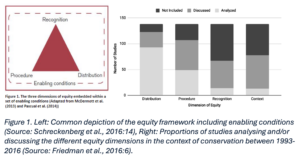
The Site-level Assessment of Governance and Equity (SAGE) tool allows actors to assess governance and equity at their PCA with the primary objective of generating practical action to improve the situation. The tool and accompanying methodologies are well-developed to allow actors to generate ideas, prioritise, and reformulate actions and develop activity plans that can address the identified governance challenges in practice. At monitoring progress meetings, site-level actors come together to review their progress in implementing these activities and identify and address any challenges faced. While the SAGE principles cover a wide range of social equity concerns at a conservation site, they do not explicitly invite actors to reflect on the wider structural and contextual dynamics that underlie governance processes at the site. Different systematic, structural, political, historical and discursive power dynamics beyond the immediate governance system at the site-level, can, however, be pivotal in creating, upholding or accelerating inequities at the site-level; and, similarly, are likely to impact the potential for formulated action plans to be successfully implemented and, if implemented, to bring about lasting change. Understanding well the enabling conditions and barriers to change thus appears an important missing piece in the SAGE cycle, but also more broadly for efforts to advance the equitable governance element of the 30×30 target. In fact, even though enabling conditions, or contextual equity, were an essential dimension of the equity framework, compared to the other dimensions, it has widely been neglected in the empirical academic literature (Friedman et al., 2018).
Across several countries participating in the “Scaling up Equitable Governance in Area-based Conservation” (SEGA) project including Kenya, Tanzania, Madagascar, Nepal and Bolivia multiple sites have now completed the SAGE process and are actively implementing their action plans. As these sites transition into the monitoring and adaptive learning phase, there is a growing need to better understand the broader enabling conditions and systemic barriers that influence whether identified actions are successfully implemented, sustained, adapted or stalled.
The research aims to understand barriers and enablers to scaling up (including scaling deep, out and up, see below Figure 2 (Riddell & Moore, 2015). Ultimately, incorporating learnings on common patterns of enabling conditions across sites into the SAGE methodology should support not only the likelihood of success of action plans and incremental institutional and cultural change towards more equitable governance at the site level (scaling deep) but also help spur interest by other sites and organisations to take up SAGE as a tool (scaling out). The theory of change for scaling up in SEGA assumes that interest in using SAGE is sparked by seeing how it can support actual governance improvements, which can only take place, if barriers are overcome or actively addressed, or accelerated if strategically taking advantage of certain context dependent enabling conditions. Similarly, the direct findings of this research can support the advocacy work directed at informing and influencing subnational and national conservation bodies and policy to help reduce identified system level barriers and build enabling conditions for better governance at the site-level (scaling up).
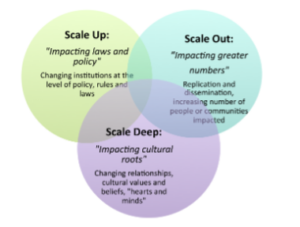
Figure 2. Scaling out, scaling up and scaling deep for social innovation (Source: Riddell & Moore, 2015:4)
Understanding these enabling and constraining conditions is therefore critical for:
- Strengthening the effectiveness of SAGE action planning and adaptive management;
- Informing strategic support by national associations such as Kenya Wildlife Conservancies Association (KWCA) and other implementing partners;
- Supporting evidence-based advocacy aimed at reducing systemic barriers and strengthening enabling environments for equitable governance;
- Contributing to learning on how equitable governance can be scaled deep, scaled out and scaled up within conservation systems.
This assignment seeks to generate systematic, practice-oriented evidence on the barriers and enabling conditions affecting implementation of SAGE action plans at selected conservation sites, and to translate this learning into practical insights that can strengthen governance programming, methodological refinement and policy engagement across the conservation sector.
Project description
Kenya has lost over 68% of its wildlife over the past five decades, driven in large part by weak governance processes and institutional structures within the conservation sector. In response, community conservancies have increasingly emerged as a viable and effective model for conserving biodiversity while simultaneously delivering socio-economic benefits to landowners and local communities. This aligns with the Intergovernmental Science-Policy Platform on Biodiversity and Ecosystem Services (IPBES) Global Assessment on Biodiversity and Ecosystem Services (2016), which recognizes that community-based and locally governed conservation systems can, in many contexts, perform as effectively and sometimes more effectively than centrally managed protected areas.
Over the past decade, Kenya’s conservancy movement has expanded significantly, with more than 240 conservancies now covering approximately 18% of the country’s landmass. These conservancies secure critical wildlife dispersal areas and migratory corridors, while also providing institutional platforms that enable communities to diversify livelihoods through improved livestock productivity, nature-based tourism, carbon initiatives, and other sustainable enterprises.
Despite this growth, many conservancies remain at an early stage of institutional development and continue to face governance capacity gaps, weak accountability systems, and limited technical and financial sustainability. These challenges undermine conservation effectiveness and equitable benefit-sharing outcomes.
Against this backdrop, the Kenya Wildlife Conservancies Association (KWCA) Strategic Plan 2024–2030 prioritizes accelerating the development of effective, resilient and inclusive conservancies that deliver positive outcomes for both communities and wildlife. A key strategic focus is the scaling of innovative governance and management assessment tools including the Site-level Assessment of Governance and Equity (SAGE) and the Management Effectiveness Tracking Tool (METT) to strengthen governance performance, accountability and adaptive management across conservancies.
This project contributes to KWCA’s strategic objectives by scaling the application of the SAGE tool to support governance self-assessment, action planning and implementation in four conservancies in Kenya: Naibunga Central Conservancy (Laikipia), Chuine Conservancy (Baringo), Mara Ripoi Conservancy (Narok), and Mwaluganje Conservancy (Kwale). In addition to the four core conservancies, the project also provides targeted technical support to Naibunga Lower Conservancy, Kiborgoch Conservancy, Lekurruki Conservancy, and Kiborit Conservancy.The project seeks to strengthen site-level governance capacity, deepen learning on implementation dynamics, and generate practical evidence on the barriers and enabling conditions that influence the effectiveness and sustainability of governance reforms in community conservancies.
Objectives
- Identify what are the key enabling conditions and barriers faced by site-level actors when implementing (or trying to implement) actions to advance equitable governance at their conservation site.
- Analyse how these enabling conditions and barriers are influenced and can be linked by broader legal, structural, historical, institutional, social and policy contexts in the past and wider society beyond conservation that have been discussed in the literature.
- Inform the role of higher-level actors, including donors, policy makers and NGO’s, in reducing systemic barrier and strengthening enabling environments that support equitable governance at site level
- Generate practical insights on how site-level actors can strengthen success, including how they can proactively leverage enabling conditions and address or adapt to barriers during action planning and implementation.
Scope of work
The consultant will undertake a structured, multi-step assignment to document and analyze the barriers and enabling conditions influencing the implementation of governance improvement actions at selected conservancies. The scope of work will include the following components:
Step 1: Preparation and Inception
The consultant will review all relevant project documentation, including SAGE reports, action plans, monitoring tools and partner guidance materials. An inception meeting will be held with KWCA and project partners to agree on objectives, methodology, sampling, data collection tools, timelines and reporting expectations. The consultant will develop and submit an inception brief outlining the agreed approach and tools.
Key Outputs:
- Inception brief and workplan
- Data collection tools and interview guides
Step 2: Participation in Monitoring Progress Workshops
The consultant will attend selected SAGE monitoring progress workshops to observe implementation dynamics, capture emerging barriers and enabling conditions, and engage with site-level actors through participatory reflection processes. Field notes and structured observation tools will be used to document implementation experiences.
Key Outputs:
- Workshop observation notes
- Preliminary thematic insights
Step 3: Follow-up Interviews
The consultant will conduct follow-up semi-structured interviews with key stakeholders, including conservancy leadership, management teams, community representatives, technical partners, and relevant government actors. Interviews will deepen understanding of institutional, social, policy and operational factors influencing implementation outcomes.
Key Outputs:
- Interview transcripts / notes
- Coded qualitative data
Step 4: Desk-Based Literature Review
The consultant will conduct a focused literature review to examine how observed barriers and enabling conditions relate to broader legal, institutional, historical, governance and socio-political dynamics within the conservation sector and wider development context.
Key Outputs:
- Annotated literature synthesis
- Analytical framework linking site findings to systemic drivers
Step 5: Analysis and National-Level Reporting
The consultant will synthesize findings from fieldwork and literature review into a national-level analytical report highlighting key patterns, implications for practice, and recommendations for site-level actors, KWCA and policy stakeholders. A validation discussion will be conducted with KWCA to refine findings.
Key Outputs:
- Draft national report
- Validation presentation
- Final national report
Timeframe
- Preparation and inception – 1 day
- Attendance at monitoring workshop(s) – 2 days
- Follow-up interviews – 4 days (2–5 interviews per day)
- Literature review – 4 days
- Analysis and report writing – 4 days
- Travel and logistics – As required
Estimated Total Level of Effort: 15 working days (excluding travel)
Final scheduling will be agreed during the inception phase based on site accessibility and workshop dates.
Consultant qualification
The assignment will be undertaken by a national-level researcher or consultant who will work in close collaboration with KWCA and IIED staff. The consultant is expected to independently carry out the primary research activities while ensuring methodological consistency and coordination across participating countries.
The ideal consultant should meet the following qualifications:
- A minimum of a Master’s degree in social sciences, development studies, environmental governance, gender studies, political ecology, conservation social science or a related field.
- Demonstrated experience in qualitative research design and implementation, including interviews, focus group discussions, participatory methods and qualitative analysis.
- Proven ability to conduct independent field research, data synthesis and analytical report writing.
- Strong understanding of governance, power relations, institutional dynamics, community-based natural resource management, conservation or development programming.
- Based in-country and familiar with national conservation governance structures, policy environments and community contexts.
- Excellent analytical writing and verbal communication skills in English.
- Ability to engage constructively with diverse stakeholders including community actors, NGOs, government agencies and donors.
- Demonstrated commitment to ethical research practices, including informed consent, confidentiality, safeguarding and respectful engagement with communities.
Application process
- A short cover letter (maximum one page) confirming interest and availability
- A consultant profile (maximum three pages) demonstrating relevant experience in applied research, governance analysis, conservation and social equity
- A technical proposal (maximum two pages) outlining understanding of the assignment, proposed methodology and analytical approach
- A proposed work plan and timeline (maximum one page)
- Professional CV(s) of the proposed consultant(s) not exceeding four pages
- Contact details of at least three referees for similar assignments
- At least one sample report from comparable work in PDF format
- Copies of relevant statutory and compliance documents where applicable.